

- On August 30, 2026
- 0
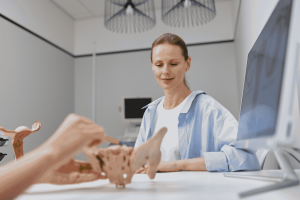 A lot of people carry around one piece of pelvic floor advice from decades ago: do your Kegels. It’s outdated for most of the population, and it’s especially incomplete for perimenopause, when pelvic floor symptoms often show up, or come back, for reasons that have nothing to do with how many Kegels you’ve done.
If you’re noticing new leaking with a cough or a sneeze, a sense of heaviness or pressure, more urgency, or pelvic floor symptoms even though you’ve never been pregnant, this is a genuinely common part of the perimenopause transition, and there’s a clear physiological reason for it.
Why the Pelvic Floor Is Especially Sensitive to Hormonal Change
The pelvic floor is a group of muscles and connective tissue slung across the base of the pelvis, and it has one of the highest concentrations of estrogen receptors in the body. Estrogen supports the thickness, blood flow, and elasticity of the vaginal and pelvic tissue, and it plays a role in maintaining the collagen that gives the pelvic floor its structural support.
As estrogen fluctuates and then declines through perimenopause, several things can happen at once:
- Tissue becomes thinner and less elastic, which can affect both support and sensation.
- Collagen quality declines, the same shift discussed in the connective tissue overview for this series, reducing the pelvic floor’s ability to absorb and manage pressure (from coughing, jumping, lifting, laughing). Learn more about how collagen changes during this time, read this article.
- Muscle tone and coordination can shift — some people develop pelvic floor weakness, while others develop a pelvic floor that’s overly tense or “gripped,” which can cause similar symptoms (urgency, discomfort) but needs the opposite treatment approach.
This is why “just do Kegels” can actually make things worse for a subset of people — if your pelvic floor is already overly tense, adding more contraction work increases the problem rather than solving it.
Symptoms People Often Don’t Connect to Perimenopause
- Stress incontinence (leaking with cough, sneeze, laugh, jump, lift) that’s new or worsening
- Increased urgency or frequency
- A sense of vaginal or pelvic heaviness or pressure
- New discomfort during penetration or exercise
- Symptoms appearing for the first time in someone who has never been pregnant or given birth vaginally
That last point matters. Pelvic floor dysfunction is often assumed to be purely a postpartum issue, so people without children, or people many years past childbirth, are sometimes dismissed or confused when symptoms appear in their 40s. Hormonal change alone is a sufficient cause.
What Actually Helps
- Get an individualized assessment before assuming you need to “strengthen.” Because both an under-active and an over-active pelvic floor can cause leaking and urgency, a pelvic floor physiotherapist’s assessment is far more useful than a generic exercise plan. This is the single highest-value step for anyone with persistent symptoms. Learn more about how the pelvic floor can be tight and/or weak in this article.
- Train the pelvic floor as part of a whole-system, not in isolation. The pelvic floor works as a team with the diaphragm and deep abdominal muscles to manage pressure in the trunk (more on this in the breathing post in this series). Exercises that coordinate breath with pelvic floor engagement tend to outperform isolated squeeze-and-release drills.
- Resistance training matters here too. As with tendons, appropriately loaded strength training, including exercises that load the pelvic floor and hips, like squats and hip hinges done with good breath mechanics, supports connective tissue and muscular capacity rather than undermining it. Avoiding all loading out of fear of leaking tends to accelerate deconditioning. Learn more about how tendon health changes during perimenopause.
- Ask about local vaginal estrogen. For many people, low-dose local (vaginal) estrogen which has minimal systemic absorption, is a highly effective, well-studied option for restoring tissue quality and reducing symptoms like urgency, dryness, and irritation. This is a conversation to have with a doctor familiar with menopause care, since it’s underused relative to how well it works.
- Address constipation and breath-holding patterns. Chronic straining (from constipation or from holding your breath during exertion, like in the gym) puts repeated downward pressure on the pelvic floor. Managing bowel regularity and learning to exhale on exertion, rather than bracing and holding, reduces cumulative load on already-vulnerable tissue.
The Reassuring Part
Pelvic floor symptoms in perimenopause are common, but “common” doesn’t mean “just live with it.” Unlike some perimenopause symptoms that are harder to intervene on directly, pelvic floor function responds well to targeted treatment, physiotherapy, appropriate strength training, and in some cases local hormone therapy make a real, measurable difference for most people. The first step is usually just getting an assessment instead of guessing. Book your appointment with our team today to start feeling more comfortable in your body!
0 comments on Pelvic Floor Changes in Perimenopause: What’s Happening and What Actually Helps